
Time Series Econometrics
Introduces statistics majors to econometric methods for analyzing time series data, building
on regression foundations. Covers OLS assumptions and diagnostics, heteroscedasticity, autocorrelation, distributed
lag and dynamic models, stationarity testing, ARIMA, VAR models, Granger causality, cointegration, error correction
models, and ARCH/GARCH models for volatility, with applications to real economic and financial data using Stata
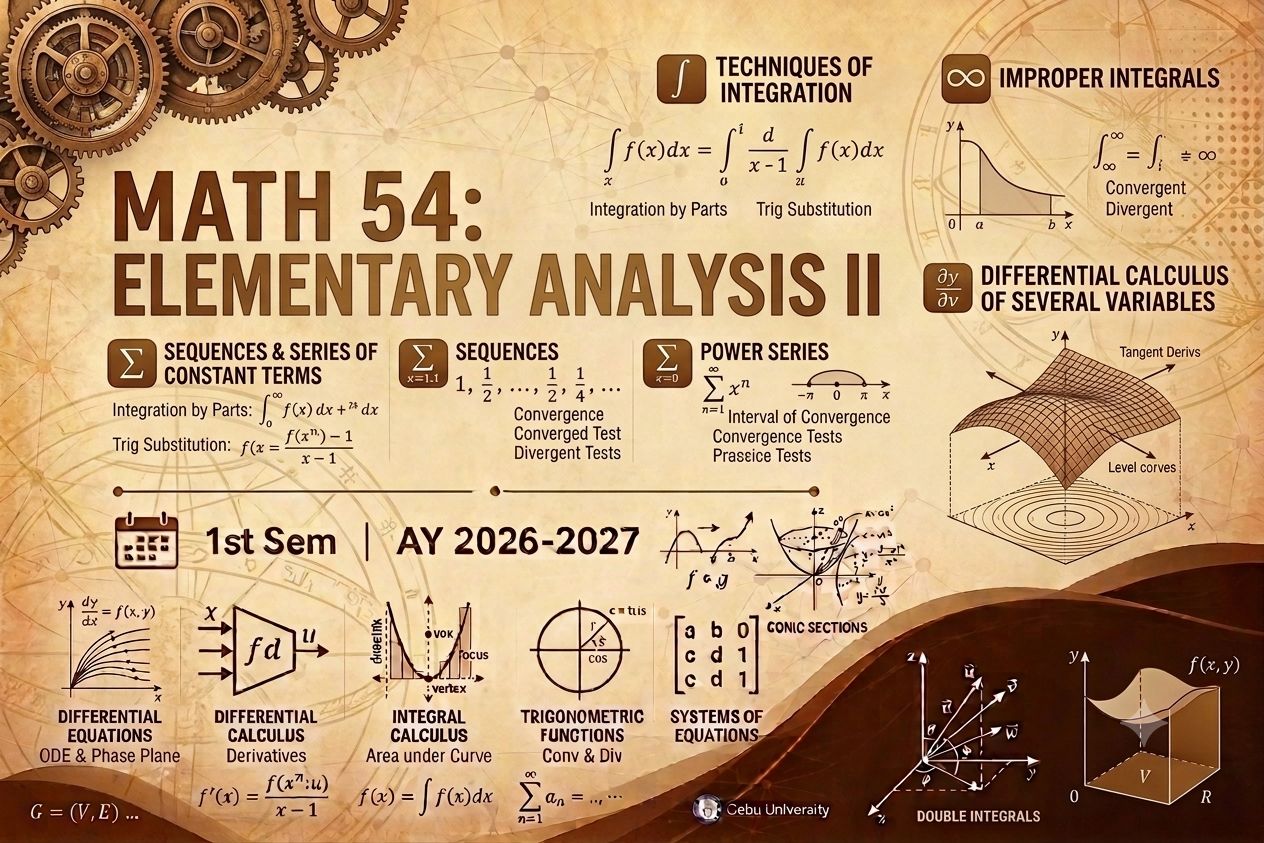
MATH 54 : ELEMENTARY ANALYSIS II | 1st Sem | AY 2026-2027
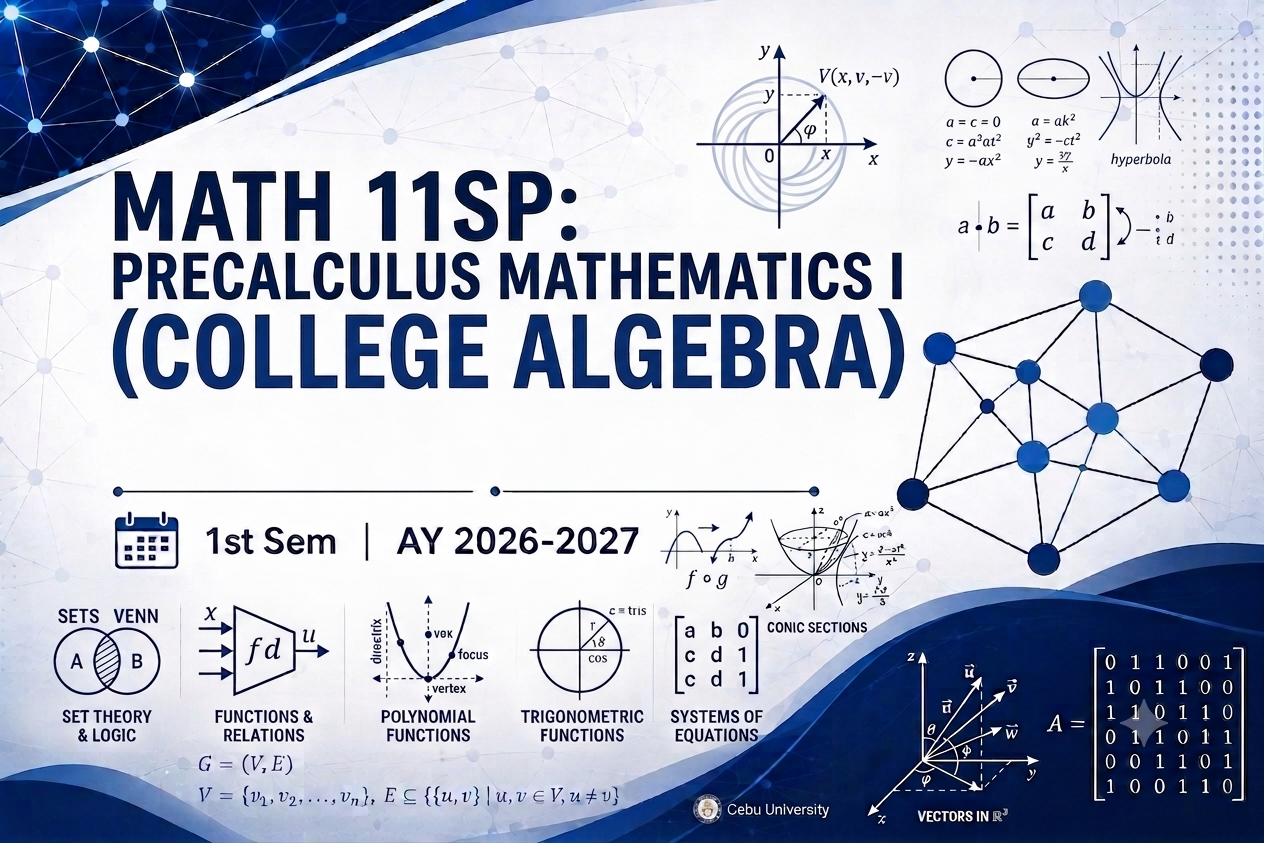
MATH 11SP | Precalculus Mathematics I (College Algebra) | 1st Sem, AY 2026-2027
- Real Number Systems
- Algebraic Expressions
- One- and Two-Dimensional Coordinate Systems
- Functions
- Equations
- Inequalities
- Word Problems
- Variations
![Math 11SP: College Algebra [1st Sem AY 2026-2027]](https://uvec.upcebu.edu.ph/pluginfile.php/126795/course/overviewfiles/geometry-cyberspace-digital-art-red-wallpaper-preview%20%282%29.jpg)
Math 11SP: College Algebra [1st Sem AY 2026-2027]
Real Number Systems, Algebraic Expressions, One- and Two-Dimensional Coordinate Systems, Functions, Equations and Inequalities, Word Problems and Variations
STAT 111-B: Probability & Statistics (1st Sem, A.Y. 2026-2027)
presentation of data; frequency distributions; measures of central
tendency; measures of dispersion; probability distributions; statistical inference; correlation and
regression
STAT 101-D: Elementary Statistics (1st Sem, A.Y. 2026-2027)
Presentation of data; frequency distributions; measures of central
tendency; measures of dispersion; probability distributions; statistical inference; correlation and
regression
MATH 40: Calculus for the Life Sciences | A.Y. 2026-2027 | Section A
MATH 40 is an introduction to calculus and its applications in the life sciences. Rather than focusing only on mathematical techniques, we will explore how calculus can be used to describe, analyze, and understand phenomena in biology and other life-science disciplines.
Throughout the course, we will encounter concepts such as limits, derivatives, integrals, and differential equations and see how these ideas can help us model and interpret real-world situations involving population growth, rates of change, biological processes, and other applications in the life sciences.
MATH 53: Elementary Analysis I | A.Y. 2026-2027 | Section H
This course covers the notions on limits, continuity, derivatives and their applications, differentials, antiderivatives, definite integrals, and its application. It gives students appreciations of how complex real-world problems can be solved through different tools of calculus such as limits, differentiation, and integration.
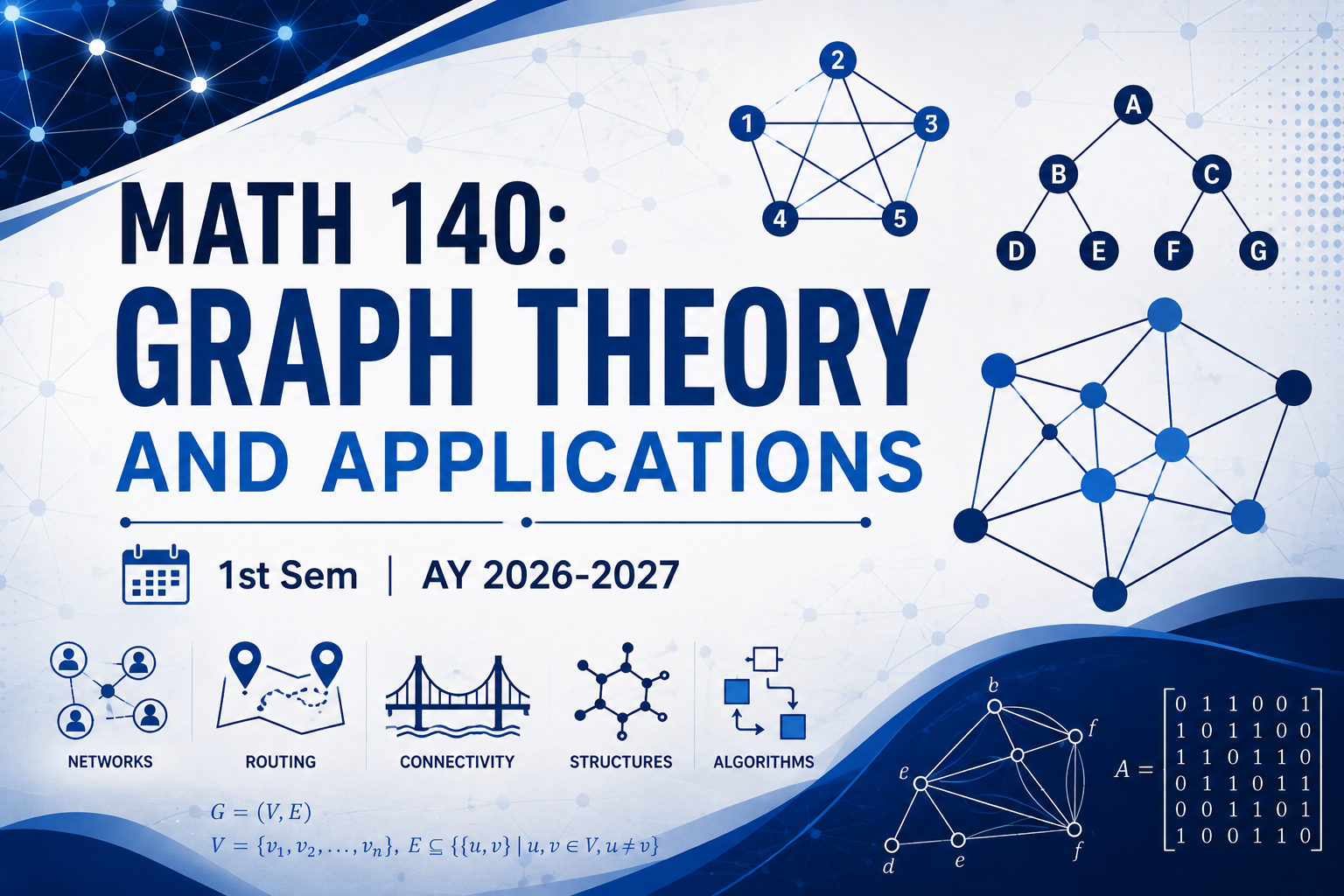
MATH 140: GRAPH THEORY AND APPLICATIONS | 1st Sem | AY 2026-2027
- Graph characterization and operations
- graphs and algorithms
- trees
- connectivity
- traversability
- matching
- factorization
- planarity
- colorability
- digraphs and tournaments
- binomial and multinomial coefficients
- pigeonhole principle and Ramsey numbers
- the principle of inclusion and exclusion
- generating functions
- recurrence relations
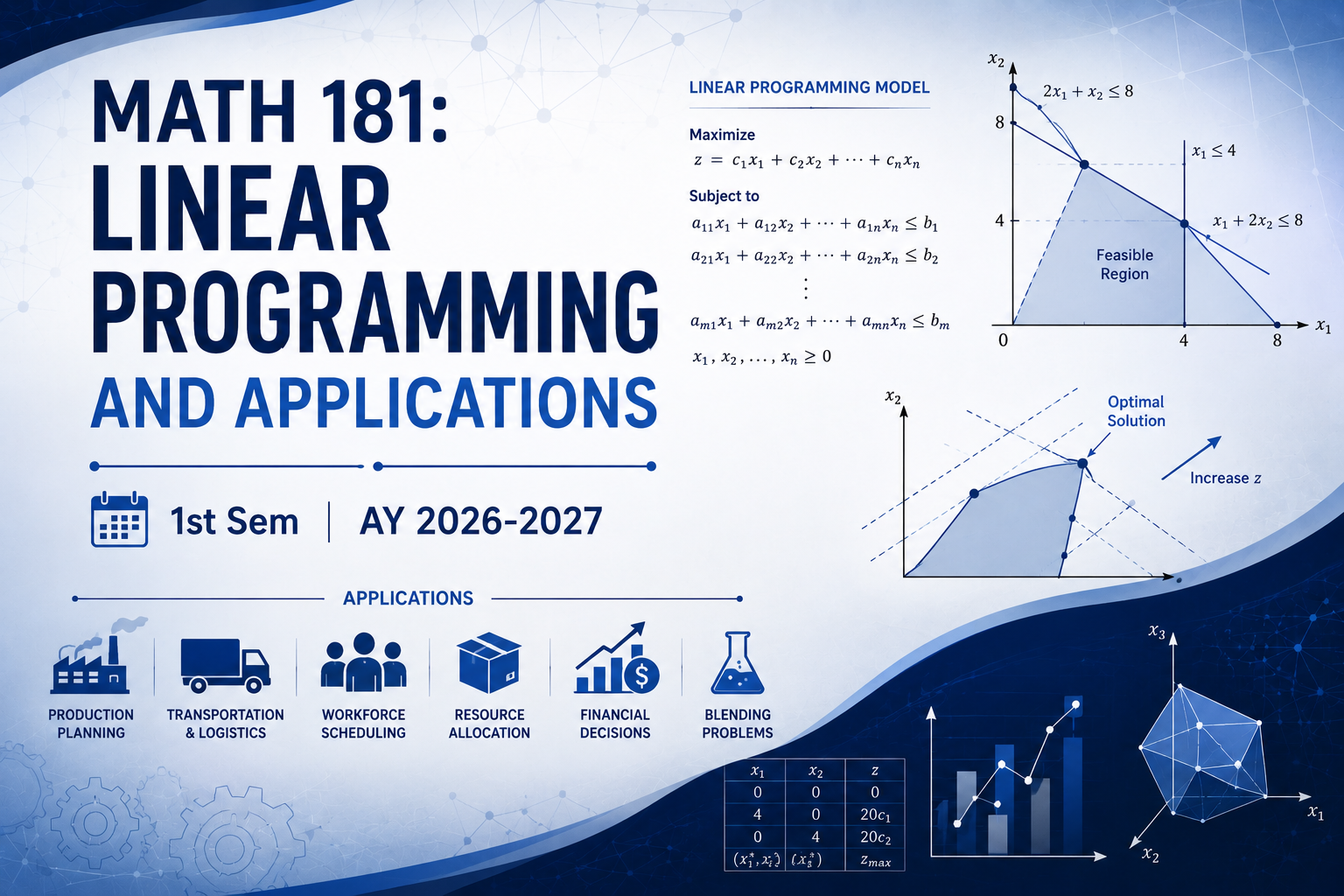
MATH 181: LINEAR PROGRAMMING AND APPLICATIONS | 1st Sem | AY 2026-2027
- Basic concepts
- problem formulation
- graphical solution for two-variable problems
- simplex algorithm and other algorithms for special LP problems
- duality
- sensitivity analysis
![Math 211: Abstract Algebra [1st Sem AY 2026-2027]](https://uvec.upcebu.edu.ph/pluginfile.php/121812/course/overviewfiles/geometry-cyberspace-digital-art-red-wallpaper-preview%20%282%29.jpg)
Math 211: Abstract Algebra [1st Sem AY 2026-2027]
Binary operations, algebraic systems such as semigroups, rings, integral domains, fields, extensions